Showing posts with label palace. Show all posts

Sunday, July 15, 2018

Paris de l’Europe: Versailles

As I write this I’m sitting in a restaurant beside the Grand Canal at Versailles, waiting for the gardens to open for the evening fireworks. I've managed to do a little bit of work today (my plan for Paris was to do half a day of work, and sightsee the rest of the time), which so far has kind of worked.

Day one, I wore my new sandals and did a few hours work by the Louvre. Then I went to buy sticking plasters for my sore feet and went back to my hostel (where they seem to have given me a two person room with ensuite, which is nice, especially as there was no one else there the last two nights I spent there). I decided to call off my Eiffel Tower trip to give my feet a chance to heal, and did some more work at one of the tables in my room (there are two tables).

Day two was Versailles. I'd managed to figure out how to get the normal travel card to add to my collection (‘Navigo', cheaper than the tourist one, but it only runs Monday- Sunday), and caught the métro and then the RER train out to Versailles, where a lot of people were also going. It was a warm day, and I was extremely glad I had bought timed tickets for the palace, which meant I could just show up at the door at a time of my choosing rather than spend an hour or more waiting in the sun to get in. I got a coffee, madeleine and salad, did some work at a café with many separate named rooms to eat in (I chose one with sparkly gold panels) and then presented myself at the palace at 1pm. Apparently you sometimes wait up to thirty minutes even with timed tickets, but I got straight in, went through security and picked up my audio guide (I'm a big fan of audio guides - otherwise you get sore eyes reading all the labels on things, and it also means I don't feel I need to read ALL THE LABELS which can get a bit over-the-top).

The palace, is, of course, amazing. I was a bit disappointed with the plain decor in the first few rooms detailing the history of the palace, but then we got to the main rooms and the effect (and amount) of gold and muralling and sculpted ceilings was just incredible. I've visited a few castles this trip where they said the king/queen etc had wanted to imitate Versailles, and it was completely clear why. The Hall of Mirrors is enormous and beautifully filled with mirrors (of course) and chandeliers and rich paintings and marble (marble is everywhere). There are more rooms, smaller but similarly richly decorated, and then you get to the vast Hall of Battles, with its skylight running the length of the room and expansive paintings detailing more than thirty great French military victories in chronological order from about 700.

I wandered through the gardens a little and enjoyed a musical fountain, then visited Marie Antoinette's Petit Trianon (her small house which, while quite small compared to the palace, is a lot bigger than my house). She ordered an English garden alongside the house, which meant excavations to make little hills and valleys and planting of trees to make it look 'wild', and also a working farm and accompanying tiny village. It reminded me a bit of Hobbiton, especially with its lake and rolling hills, and the idea of a constructed pastoral scene. I also saw two otters, which are quite different from the Malaysian otters I've seen in zoos in NZ.

After dinner (aforementioned) I went back into the gardens for the night fountains and fireworks, which you have to pay extra for but which I think was worth it. It runs on Saturday nights in summer, and you wander through the gardens in the dusk light enjoying baroque music (I think) and enjoying the fountains, some of which are decorated in smoking dry ice and coloured lights. I think my favourite fountains were the colonnade fountain (dry ice and lasers in a ring of pillars), the Mirror Fountain (the fountain spouts move! I want to know if they moved in Louis XIV's days) and the Ball grove, which had fire a waterfalls with lights in them, as well as dry ice. Apparently there is no water source at Versailles, so the amount of engineering needed to make all the fountains work is quite incredible, especially done centuries ago. Much, if not all, of the piping is original.

The finale was a fireworks and flame show by Groupe F, with a line of flaming torches going off in patterns up the main 'perspective' as well as fireworks, all to music. Louis XIV probably would have enjoyed it.

Then it took two hours to get back to the hostel, half an hour of which was spent packed on a train waiting to leave Versailles (people clapped when the train finally started to move). But it was worth it.

Monday, July 2, 2018

Sweden! Uppsala

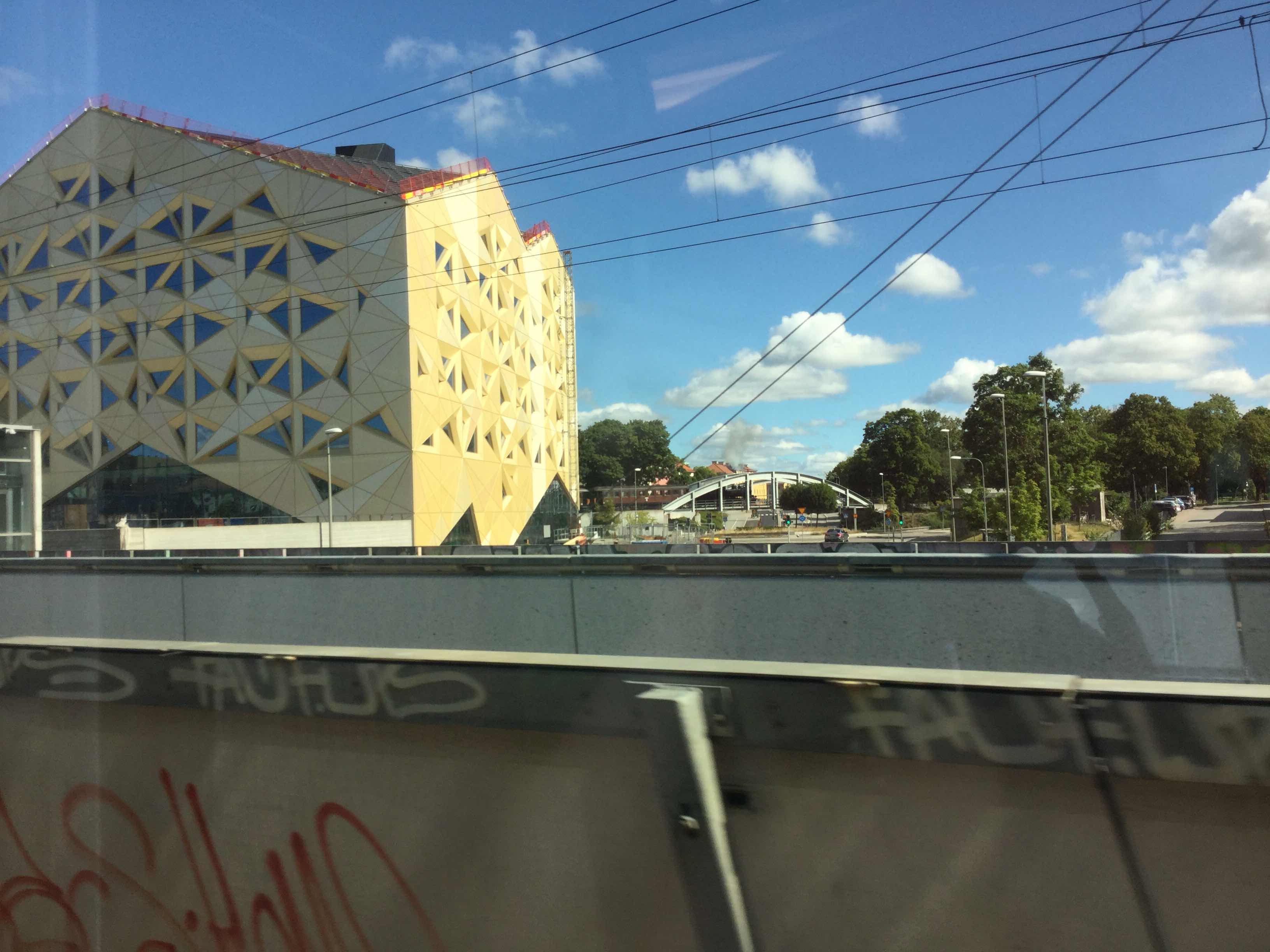
I'm sitting in a train on the way to Stockholm after spending the week in Uppsala, a small city north of Stockholm. It's just past midsummer, so it never really gets dark and - OH I JUST SAW A STEAM TRAIN, puffing its way across a bridge with olde carriages. Here is the steam train:

Now we are going really fast past a lot of fields, definitely faster than Sydney trains and much faster than NZ trains. Anyway, I’ve been in Uppsala at a conference (which was good), and in the meantime have been wandering around the older parts of the city, which has a canal, lots of cobblestones, many many bikes and very few cars. We had 30 degrees ones day, which I was not prepared for, but then it fell to 17 the next day so I suppose it balanced out.

Uppsala also has the largest cathedral in Scandinavia, with construction starting in the 13th century and several rebuilds since. The stone interior has been painted with beautiful repeating patterns of flowers and other motifs, different in every small chapel to the sides of the cathedral, which at first I thought was original, but then found out it was repainted in the twentieth century, so more in the spirit of the original. It made me think about buildings as living, and wonder why many of the buildings from the English reformation haven't been renewed - perhaps to do with continuity of use and political stability, as well as displaying the scars of the past.

Eating out in Sweden is quite expensive, apparently due to the high tax on luxuries. There are lots of restaurants beside the canal that runs through the city, looking out to the water and the small bridges that cross, some decked out with flowers. The route from my hotel to the conference venue took me along the canal, beneath the castle (pink), along cobbled streets around the cathedral, and past some grand old apartment houses (one painted sky blue). People in Sweden tend to live in apartment houses in cities in Sweden, with parks nearby and a very compact form with fields not far from the centre of town. There are trees everywhere and rough paths through the parks which gives everything a sort of half-wild quality. Linnæus of the botanical scientific naming system lived and worked in Uppsala, so there are lots of references to him - cafés, a tourist walk, and of course his house and garden. We went through the garden beds where he cultivated a whole host of different plants, for instance about ten types of thistle in one bed, laid out by genus and Latin name.

Dinner one night was in the state hall at the castle, which we found out later is not generally accessible to the public. It's a huge space, with a musicians gallery around one corner, and long tables with candelabra. The waiters were extremely well-rehearsed, at one point carrying in silver platters of icecream over one shoulder, turning to stand in a line with military precision and lighting the flares sticking out of the icecream. We were also treated to some musical comedy (spex) by a male choir with their mascot, Flora the cow skull. They'd chatted to one of my colleagues outside and now asked for her to come up to the stage so they could sing her a love song, but she hid so they asked for volunteers, and ended up singing their song to a guy, with much feeling.

As I write this last bit I'm in a train on the way to Copenhagen at 200km an hour, passing fields and forests, red farmhouses and little lakes. The weather's beautiful, with blue skies and a crisp morning. I'll get onto my Stockholm adventures in the next post :)

Saturday, January 19, 2013

Snow and the Tower of London

It's cold here, though not quite cold enough for proper snow blankets. We were promised snow falling ALL WEEKEND, but I looked out the window this morning and the snow in the back garden is sinking sadly into the grass in patches.

Yesterday I walked along the Thames in the snow (retracing Bond's London car chase in Skyfall), past MI6 and along to Westminster. There was a team playing football on the green outside Westminster, snow floating around them. I was very glad of my thermal top, my knitted tunic, my half-mohair jersey, my blue coat, my sheepskin ugg boots, and my hat, scarf and gloves. Not sure how they were doing in their shorts and t-shirts.

From Westminster I got a Circle line train to Tower Hill, and wrapped up In preparation for the Tower. You enter via a drawbridge over the snow-white expanse of the grass moat, and walk along Water Lane, which is built on wooden pilings over the Thames. We had a short talk from one of the Yeomen Warders (aka Beefeaters) in the Chapel rather than around the grounds, because it was pretty cold outside. He told stories about the history of the Tower, and the executions that had taken place through the centuries, before informing us that the bodies had originally been buried exactly where we were sitting, with so many thrown in under the stones that the floor was higgledy-piggledy uneven. Most of them were exhumed and reburied in Queen Victoria's time, but some, including Anne Boleyn, were still under the altar.

I've become a great fan of audio-guides in my time in Europe - you can listen and look at the same time. Much of the audio-guide at the Tower takes place outside, so I was determined to stick it out through the snow with frozen fingers. I would get the full experience! I would hear and see all the Tower had to offer!

I went through the Medieval Palace above the Traitor's Gate, and saw a recreation of a King's chambers. Through a staircase and over a bridge was a beautiful octagonal room with vaulted ceilings, and up another spiral staircase I found the battlements of the inner wall. About this time, I realised I only had forty minutes left until the Tower closed, so I stopped looking at everything and made a shortlist (They tell you three hours is a 'long' time to see the Tower. In future, I think I should take all the maximum times for things and double them. I like to take my time...). So... around the battlements, and on to the Crown Jewels!

There are lots of very expensive things in the Crown Jewels, as you may think. The number of gold plates and sceptres and goblets was truly incredible, and then we came to the crowns. I hadn't quite realised that they don't generally reuse crowns - there's a new one (or two or three) for each monarch. And they all have lots of very sparkly jewels in them that glint in the light as you move slowly past on the tourist conveyor belt. There weren't that many people - I guess it's a good time to go to the Tower when it's snowing - so I was out quite quickly and heading for the White Tower, which is the big square one that you probably think of when you think of the Tower of London. It was built by William the Conqueror, and at the time was the tallest building in Europe.

The entrance to the White Tower is on the first floor and has wooden steps leading up to it - this meant that, in a siege, you could destroy the wooden steps and no one could get in. An opening in the stone wall halfway up the stairs shows where the bodies of the two Princes in the Tower were apparently found, which was quite creepy. It's strange to come across places where famous things you've learned about actually happened.

Inside is an exhibition of armoury, including a few sets of Henry VIII's. He was tall and pretty imposing, judging from his armour. There are also swords and horse armour and guns and the 'Line of Kings', which is a set of life-size models of kings and horses made in the seventeenth century. One of the sets of armour holds the world record for tallest armour, and another displayed right beside it is one of the smallest and looks like it was made for a three-year-old.

The warders began to usher us out, so I took a last few listens of my audio-guide and reluctantly gave it back. I hadn't had time for the Bloody Tower or the Queen's residence, but I didn't think the Yeomen Warders would appreciate me hiding in a tower room and exploring the rest in darkness.

It had stopped snowing, and everything was glowing in the dusk and lights. I took the DLR to Canary Wharf and admired the fairy lights and glowing paper boats floating in the water, and then was off home.


Monday, November 19, 2012

Vienna Day 4: Walking Tour, Wiener Schitzel and St Stephensdom

Today was my last day in Vienna, and I was determined to get the walking tour that sets off from an associated hostel every second morning. We set out and got to the meeting point five minutes too late, but a man at the desk told us we could probably catch them up. After a bit of confusion about how long they could be possibly taking through the market, the large group appeared and we tagged on to them.

Our guide was very good, explaining all about the buildings and history of the city. The first building we saw was the one I may have mentioned the other day with the gold dome - the Secession Building. It was built as a gallery for artists who wanted to move away from the traditional styles at the turn of the twentieth century, and was the first art gallery to have clean white walls and very little decoration, in order to show off the art.

Next was the Vienna Opera House where you can see an opera for 3€ if you stand, and then the beginning of the Vienna Palace, which is a collection of buildings that goes on and on and on. Some of it is now used as an art gallery, some as libraries, and some as state offices.

It seems strange that you can just walk among all these buildings, staring up at the windows from the small courtyards and alleyways between them, where once I guess these were heavily guarded areas of the city. We also went past the Sacher Hotel, which I'm not exactly sure how to spell, but it's why the famous Sacher Torte is named as it is, and is also where that famous picture of John Lennon and Yoko Ono in bed was taken.

We walked down some of the most expensive shopping streets, and past an incredible monument to the plague that stretches up in three levels and has far more gold than you'd think would be on a monument outside H&M. The first level has an angel driving the personification of the plague into the ground, the next has the emperor with his gold sword praying on his knees (the only public place in Europe you will see a monarch on their knees) and above him are more angels and God.

The guide left us with recommendations for lunch, so a few of us had a good meal in a wood-panelled restaurant off a little alleyway. I was a bit worried about the Wiener schnitzel because I don't much like pork, but it was actually very good and came with salad and everything. No tomato sauce was required.

Nearby is the cathedral of St Stephen's, which we took a wander around inside after our lunch. It was once the tallest building in the world, and is pretty impressive from the outside with its towering pillars, incredible stonework and gold-and-black tiled roof. It was bombed during WWII, but was restored and reopened in 1955. You can't really tell there was ever anything done to it.

It was almost time to get my bus to the airport, so we went back to our hostel to get my bag. Now I'm sitting in the airport ...

... that was me realising that the screens said my flight was already boarding, and me realising that the gate was actually a lot farther away than I thought, and deciding that, though nice and modern, this airport possibly isn't very well designed because it's never quite clear how many more barriers and travelators there are until you reach your destination.

Incidentally, the flight is not boarding. They lied. Ah well. At least I'm here now. And contemplating the fact that I am severely behind on my word count for NaNoWriMo. This is what happens when you miss a day...


Vienna Day 3: Schönbrunn, Christmas Markets and Viennese Apartments

On Sunday the One Who Speaks Russian and I rose for our all-you-can eat hostel breakfast, which included boiled eggs, salami, capsicum and cucumber as many European breakfasts seem to. We loaded up on emergency supplies of Nutella and set out to walk to Schönbrunn, the Palace of the Habsburgs outside old Vienna proper.

The mist had come in overnight and everything had a silvery white light to it, so much so that from a distance things seemed covered in a light dusting of snow. The Palace is incredibly large and stately, with mirrored staircases leading down from main doors between the two wings. You can imagine Cinderella leaving her glass slipper on these steps. They were still setting up a Christmas market in the courtyard in front of the place, but they had an enormous Christmas tree up and decorated with baubles.

We walked around the side of the palace and through the gardens with their little hedges and dozens of statues. Everything is set up along a symmetrical line leading from the centre of the palace to the Neptune Fountain, and then up the hill to the Gloriette, a beautiful airy classical building with arches. It wasn't quite symmetrical (some of the trees on one side of the gardens are taller) but pretty much everything else was. After the zigzag climb up the hill we sat in the Gloriette and drank tea and coffee, which comes with a glass of water in Austria, and marvelled at the misty view over the palace and city beyond.

Next was the tour of the palace itself. You had to buy tickets at the main gate, so The One Who Speaks Russian offered to get them while I sat on a bench and nursed my legs, which were a bit sore after all the walking. I think next time I come to Vienna, I won't break my foot in the weeks beforehand.

The Palace rooms are incredible. They're mostly done in Rococo style, with curling gold mouldings everywhere and incredible crystal chandeliers. There are paintings covering entire walls that took years to complete in one room, and then you go into the next room and there are more paintings that took years to complete, and in the next room too. You can see they had a lot of money.

Marie Antoinette was a Habsburg daughter, and there is a portrait of her as a young girl in one of the rooms. A bit further on is the room where Mozart played for the Empress when he was six years old. I had heard of this concert, and it was absolutely surreal to be in the actual room where it had occurred.

At last we went into the Great Hall, which I actually gasped on seeing. The ceiling is three incredible frescoes of the Imperial family and the Austrian Empire in general, and flickering candelabra line the walls (the flickering effect is achieved by having the electric candle bulbs in springs that bobble in the wind. Actually quite tasteful). The ceiling is high and the walls are covered in curling gold designs. Unfortunately no pictures are allowed in the palace.

We took the underground to the Christmas market outside the Rathaus, which is the most famous and the busiest. It was just on dusk, and though the crowds weren't as thick as those we saw later, it was still a mission to get through everyone and see the stalls you wanted. Most of them sold food, but there were also lots of Christmas decoration stalls and a lamp stall among other things. We decided to make for TOWSR's friend's hostel, which is actually an apartment that she has entirely to herself at the moment.

The apartment is on the first floor, and you open the main door into a cobbled entranceway, climb some marble stairs, go along a corridor with an ornate stone water basin on the wall (dating from the time of the very first piped water, I'm guessing) and into the apartment. We had a lovely evening with dinner and a movie in the warm apartment, then set off for our own hostel.